Location: Harwell Science and Innovation Campus, Oxfordshire, UK
Facility Size: 150,000 sq ft
Client: Vaccine Manufacturing and Innovation Centre – VMIC
Technology Partner: Suncombe Ltd
Main Contractor: BES
Completion: 2023–2024
Original Concept and Development
The Harwell Campus facility was originally conceived as the UK’s first dedicated Vaccine Manufacturing and Innovation Centre (VMIC). Established in 2018 through a partnership between the University of Oxford, Imperial College London, and the London School of Hygiene & Tropical Medicine, the centre was envisioned as a national resource to accelerate vaccine development and manufacture. Funded by UK Research and Innovation (UKRI) with support from industry stakeholders including Janssen, Merck, and GE Healthcare, VMIC was designed to fill a critical infrastructure gap for late-stage vaccine manufacturing in the UK.
VMIC aimed to provide surge capacity in the event of pandemics, support rapid-response production for emerging pathogens such as Ebola and Zika, and foster industrial innovation in advanced vaccine platforms like mRNA and viral vectors. The goal was to create a cutting-edge facility capable of rapid scale-up from research to GMP-compliant production, with training infrastructure and symposia supporting the development of future vaccine scientists and operators.
As the COVID-19 pandemic unfolded, VMIC’s role became even more vital. Although the facility was still under construction, the UK government rapidly increased funding and expedited development timelines, recognising its potential as a critical national asset. This early strategic investment enabled the site to position itself as a cornerstone of the UK’s long-term pandemic preparedness and bio industrial capability.
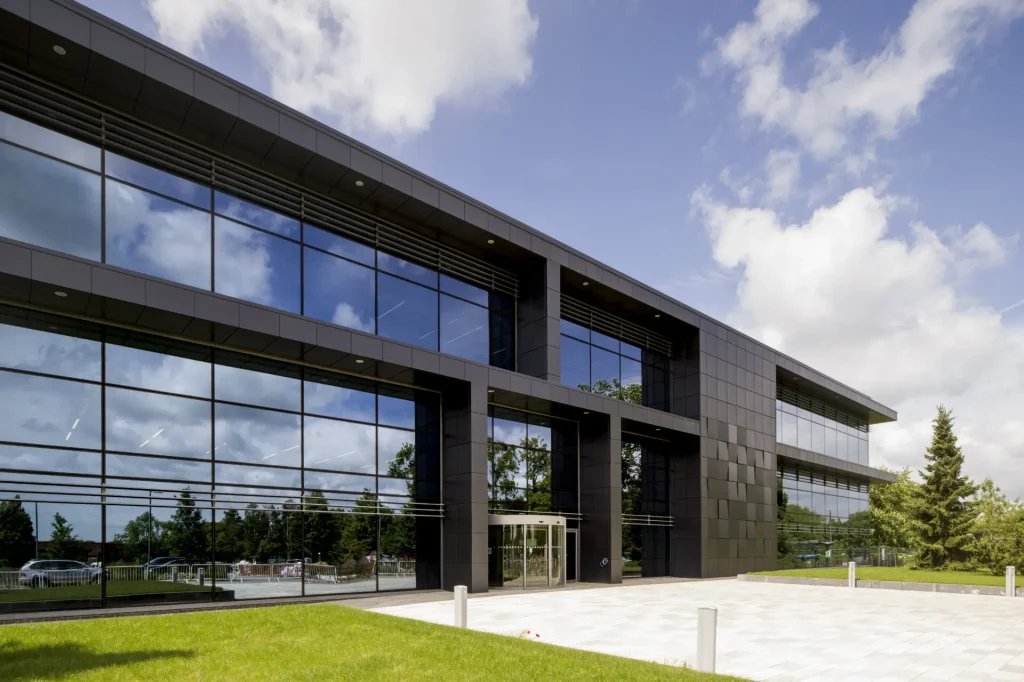
Facility Image courtesy of VMIC Harwell
Following the facility’s completion, Catalent Biologics acquired and integrated it into its global network of biologics CDMO operations, building on VMIC’s foundations while expanding the facility’s scope to offer full-spectrum biologics development and manufacturing services. Catalent Biologics is a leading global contract development and manufacturing organization (CDMO) supporting the development and commercial delivery of biologic therapies, vaccines, and advanced modalities. The Harwell facility represents Catalent’s flagship UK investment and forms part of a wider network offering end-to-end solutions from development and manufacturing to fill/finish and clinical trial supply.
Suncombe Introduction
Suncombe Ltd, a UK-based manufacturer with over 60 years of experience in hygienic process engineering, is renowned for designing and supplying advanced Clean-in-Place (CIP), Biowaste Decontamination, Effluent Treatment and Process Transfer Systems. Serving global biopharmaceutical, high-containment and research markets, Suncombe is widely trusted for GMP-compliant, highly automated and fully validated process infrastructure.
With a history of collaboration with major pharma players such as Pfizer, GSK, Merck, and ThermoFisher, Suncombe was selected as a trusted partner for the Harwell facility to deliver critical manufacturing and utility systems.
Client Requirements
The new biologics centre required a high-throughput, flexible and validated infrastructure to support scalable vaccine development ranging from ten litres to one thousand litres, manufacture mRNA, viral vector and protein-based vaccines, ensure containment and inactivation of high-risk biologic waste, comply with GMP, MHRA and global pharmaceutical regulations, offer redundancy and automation across key systems, and rapidly transition from research and development to emergency pandemic-scale manufacturing.
The facility was designed to incorporate four GMP-compliant cleanrooms, each engineered to operate independently, enabling simultaneous manufacturing campaigns across various modalities. These cleanrooms are classified as Biosafety Level 2 (BSL-2), suitable for the production of non-replicating viral vectors and live attenuated viral vaccines. While initial production scales range from 10 litres to 200 litres, the infrastructure is future-proofed with the capability to scale up to 1,000 litres. This approach ensures highly efficient, flexible, and scalable manufacturing processes in readiness for potential product licensure.

Image of Large Scale Storage and Mixing Vessels
Suncombe Solution
Working closely with the main contractor BES and project stakeholders, Suncombe designed and delivered a fully integrated suite of critical process and waste treatment systems, optimised for the stringent demands of modern biologics production.
The scope included a high-capacity media preparation suite, Cleaning-In-Place (CIP) systems, contained waste handling units, dual-stream BioWaste Decontamination Systems (BDS), hot waste collection and neutralisation skids, and modular acid/alkaline chemical dosing units. All systems were fully automated and interconnected using a centralised Siemens S7-1500 platform, developed in-house with Suncombe’s proprietary ControlSuite3000 software suite—offering compliance with GAMP5 validation frameworks and 21 CFR Part 11 electronic records.
A key strength of the project was the design integration across all Suncombe systems, ensuring not only physical compatibility but also coordinated functional logic and inter-system communication. CIP systems were linked directly to the media preparation and biowaste vessels via a centralised control architecture, enabling context-aware cleaning routines based on batch scheduling and equipment utilisation. The BioWaste Decontamination System (BDS) was engineered to receive real-time waste stream inputs from both production and cleaning circuits, allowing automated stream segregation, thermal treatment sequencing, and safety interlocks with the neutralisation plant.
Chemical dosing modules were synchronised across both media prep and BDS functions, minimising reagent consumption while maintaining validated setpoints. Meanwhile, Suncombe’s ControlSuite3000 ensured seamless recipe-based operation, real-time monitoring, audit trail recording, and integrated alarm handling across all systems.
This level of design integration not only streamlined commissioning and validation but also laid the foundation for long-term operational flexibility, scalability, and regulatory compliance.
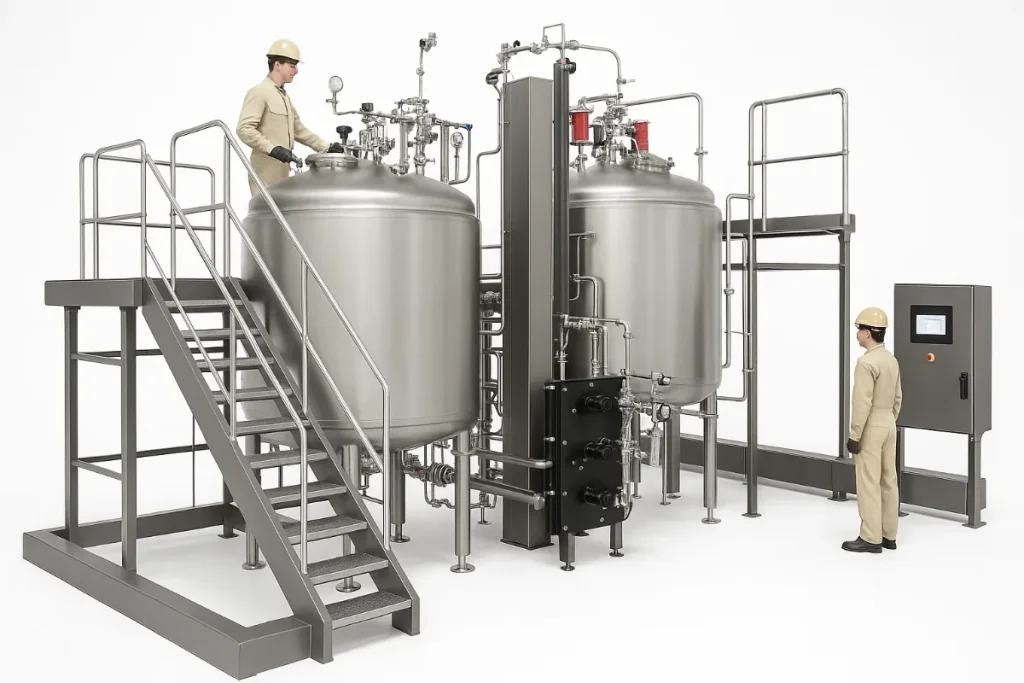
Image of Media Preparation System
Scope of Works
Suncombe’s contract scope encompassed the complete lifecycle delivery of integrated process and effluent treatment systems—starting from front-end design through to final validation support. This included:
- Detailed Functional and Technical Design: Development of full Functional Design Specifications (FDS) and coordination with all client and main contractor teams to ensure alignment with process philosophies, containment protocols, and site-wide GMP strategies.
- P&ID Development and Alignment: Iterative design and alignment of Process and Instrumentation Diagrams (P&IDs) to reflect client process flows, interlocks, and critical control points. This included bespoke additions for waste segregation, dual-stream treatment logic, and automated CIP cycles.
- 3D Modelling and Design Integration: Full 3D modelling of all skids and modules to ensure spatial fit, maintainability, service routing, and ergonomic access—coordinated with the project’s federated BIM model.
- Fabrication of Modular Skid-Based Systems: Off-site construction and FAT-ready assembly of Suncombe’s stainless steel skid-mounted process units, including media prep vessels, CIP skids, BioWaste Decontamination Systems, and neutralisation tanks, with hygienic and sanitary design per ASME BPE and GMP guidelines.
- Smart Control System Integration: Full automation and control system design incorporating Siemens S7-1500 PLCs, remote I/O, and ControlSuite3000 integration, with seamless interfacing to the client’s SCADA and site-level control networks.
- Factory Acceptance Testing (FAT): Comprehensive FAT procedures including hardware simulation, software emulation, and functional logic testing for all operational sequences, interlocks, alarms, and safety protocols.
- Delivery, Installation & Commissioning: Coordinated delivery and mechanical installation at site, followed by on-site commissioning, loop checks, and integration into the wider facility infrastructure in collaboration with BES and client teams.
- Testing, Qualification & Validation Support: Provision of full Site Acceptance Testing (SAT), Installation Qualification (IQ), and Operational Qualification (OQ) documentation packages, with Suncombe providing active support during validation execution and subsequent regulatory inspection readiness.
- Training & Handover: Operator and maintenance training, final system documentation, and project close-out services including O&M manuals, wiring schematics, software backups, and long-term support agreements.

Image of Contained Waste System
Implementation
From initial concept development through to final commissioning and validation, Suncombe worked as a fully integrated partner alongside the BES project team, contributing proactively at every project stage. The implementation phase was characterised by a series of technical, regulatory, and logistical challenges, all of which were navigated through close collaboration, agile planning, and deep domain expertise.
The project operated under compressed delivery timelines, driven by the urgent national requirement for pandemic-response manufacturing readiness. In response, Suncombe accelerated design cycles using modular fabrication strategies and fast-tracked procurement. Skid-based systems were pre-assembled, tested, and FAT-approved off-site, significantly reducing installation and validation time on site.
All systems were developed and delivered in accordance with stringent cGMP requirements, adhering to GAMP5 software lifecycle standards, and fully supportive of regulatory expectations from MHRA, FDA, and future EMA submissions. Suncombe’s proprietary automation platform, ControlSuite3000, enabled tight integration of process, utility, and safety interlocks, with recipe-based sequencing and comprehensive alarm management across all systems.
The implementation phase concluded with fully integrated Site Acceptance Testing (SAT) and joint execution of IQ/OQ protocols, with real-time system simulation and client-side approval for each mode of operation.
Testing and Validation
A rigorous and fully documented testing and validation programme was executed to ensure all systems met or exceeded regulatory, functional, and operational expectations prior to handover. Suncombe’s validation approach was built around a GAMP5-compliant lifecycle model, incorporating risk-based strategies, structured reviews, and stakeholder engagement throughout.
Each subsystem underwent a staged pre-delivery validation process beginning at Suncombe’s manufacturing facility. This included:
- Factory Acceptance Testing (FAT) with dry-run and wet testing, encompassing all operational sequences, alarm states, interlocks, cleaning cycles, temperature profiles, dosing rates, and safety shut-offs.
- Automation simulation testing using emulated inputs/outputs and virtual PLC environments to verify sequencing logic, PID control loops, HMI functionality, and remote SCADA interface.
- Full documentation package review, including Design Qualification (DQ), Functional Design Specifications (FDS), Input/Output (I/O) lists, Instrumentation Calibration Certificates, and Installation and Operational Qualification (IQ/OQ) protocols.
- Due to COVID-19 restrictions, a number of FAT sessions and documentation signoffs were carried out remotely via secure video conferencing, with real-time data sharing and remote desktop access enabling live client participation and approval.
Following successful FAT and site delivery, each system progressed through Site Acceptance Testing (SAT) under strict pandemic safety protocols. This phase involved:
- On-site loop testing, commissioning, and full I/O verification between Suncombe’s skids and the client’s distributed control systems.
- PLC-to-PLC communication testing, validating all interfaced process operations between dosing modules, biowaste collection vessels, and effluent treatment systems.
- Execution of interlock and fail-safe condition testing, ensuring proper sequencing, batch control integrity, and containment safeguards.
- Finalisation and witnessing of IQ/OQ protocols, including verification of utility connections, system pressure hold tests, sterilisation routines, alarm/response trials, and log file outputs compliant with 21 CFR Part 11.
Throughout testing and validation, Suncombe maintained close alignment with client Quality and Validation teams, providing traceable calibration records, as-built documentation, software version tracking, and full audit trails for every process module.
This comprehensive testing regime ensured not only compliance with MHRA and FDA expectations, but also laid the foundation for long-term GMP manufacturing readiness, giving the client confidence in system performance, reliability, and regulatory standing from day one.

Image of Human Machine Interface (HMI)
Installation and Commissioning
Suncombe’s field installation team coordinated closely with BES and the Catalent commissioning agents to pre-validate equipment off-site to streamline cleanroom installation, deploy modular skids with minimal disruption to concurrent trades, complete loop checks, alarm verifications, and performance qualification (PQ), and provide training and GMP operator handover sessions.
Suncombe Comments
In challenging times, we are proud to use our expertise to support the fast-tracked delivery of this nationally significant — and the UK’s first — vaccine development and manufacturing centre.
“This project represented a landmark opportunity to support the UK’s strategic vaccine capability through innovative process design and robust engineering execution. We’re proud to have contributed to this critical national infrastructure, enabling rapid vaccine deployment and long-term biopharma readiness.”
“Delivering this scale of integrated dosing, waste treatment and media preparation capability on a compressed timeline required close collaboration and trusted expertise. We thank BES and the VMIC leadership team for their professionalism and vision.”
— Steve Overton, Director, Suncombe Ltd