At a Glance
Sodium hydroxide or NaOH is highly effective for removing organic residues in CIP but is prone to crystallisation at higher concentrations. Suncombe’s CIP systems control NaOH dosing, dilution, and heating to maintain stability, safety, and cleaning consistency and deliver reliable, compliant, and efficient performance across pharmaceutical, biotech, and food production units.
Cleaning in Place with NaOH
Sodium hydroxide (NaOH), also known as caustic soda, is one of the most widely used cleaning agents in CIP (Clean-in-Place) systems across the pharmaceutical, biotech, food, and beverage industries. When used correctly, it provides exceptional cleaning performance, especially for removing organic residues such as fats, proteins, and biofilms. However, its use requires careful management of concentration, temperature, and storage stability.
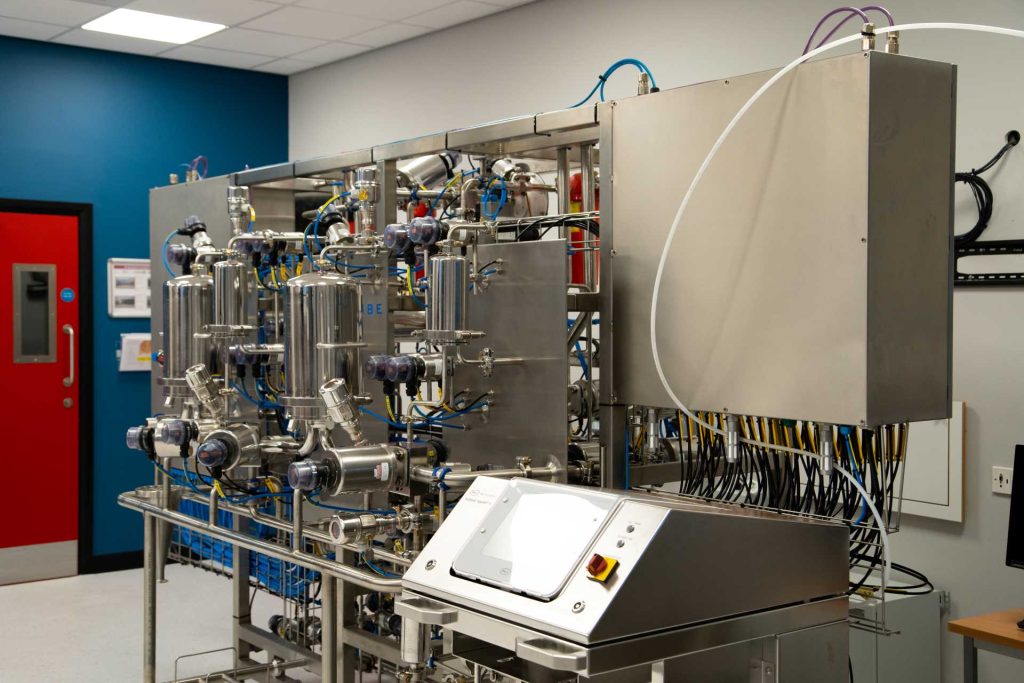
At Suncombe, we design CIP systems with the precise controls needed to ensure repeatable, safe, and effective NaOH dosing, while mitigating risks related to freezing and crystallisation. In this guide, find out how we use NaOH for cleaning in place and address the associated challenges.
Why Use NaOH in CIP?
NaOH is a strong alkaline detergent that:
- Saponifies fats and dissolves proteins
- Breaks down organic soils and microbial films
- It is cost-effective, readily available, and effective in low concentrations
- Compatible with stainless steel and many materials used in hygienic systems
Its ability to clean organic residues makes it the go-to agent for CIP Stage 1 cleaning, often followed by an acid rinse to remove mineral residues.
Common NaOH Concentrations in CIP
Typical cleaning-in-place cycles use NaOH at concentrations of:
| Application | NaOH Concentration (w/w%) |
| Light cleaning / rinse booster | 0.1 – 0.5% |
| Routine organic residue removal | 1 – 2% |
| Heavy-duty/periodic cleaning | 2 – 3% or higher |
Higher concentrations increase cleaning power but also raise concerns related to chemical compatibility, operator safety, and temperature sensitivity, particularly regarding freezing and crystallisation.
Freezing and Crystallisation Risks
NaOH is hygroscopic and tends to absorb CO₂ and moisture from the air, forming sodium carbonate and reducing effectiveness. But the bigger challenge lies in its freezing point.
| NaOH Concentration (w/w%) | Freezing / Crystallisation Point (°C) | Notes |
| 10% | –12°C | Remains liquid in all normal conditions |
| 20% | –25°C | Very low freezing point |
| 25% | –15°C | Still below zero |
| 30% | –10°C | No crystallisation risk above freezing |
| 32% | –9°C | Often used industrially; no ambient-temp risk |
| 50% | +2°C to 12°C | Can crystallise just above freezing |
High-concentration NaOH solutions (particularly ~50% w/w) begins to crystallise or solidify if stored below about 12 °C, which means they may solidify under typical cool-weather or unheated storage conditions. This unusual behaviour is due to NaOH’s strongly non-linear freezing curve, where freezing point rises sharply above ~35% concentration.
Crystallisation leads to:
- Blocked pipework and dosing lines
- Inconsistent dosing
- Reduced cleaning effectiveness
- Equipment damage from expansion or abrasion
How Suncombe Addresses This Challenge
Suncombe’s CIP systems are designed to avoid the risk of crystallisation while maintaining optimal cleaning performance:
1. Optimised Concentration Management
- We recommend using <30% NaOH for storage, with on-demand dilution for dosing
- For cleaning use, 1–2% NaOH is typically dosed into the cleaning loop
2. Insulated and Heated Storage Solutions
- Our CIP skids can be fitted with jacketed or electrically heated tanks
- Optional trace heating and lagging for pipework
- Temperature sensors ensure a safe buffer above freezing thresholds
3. Automated Dosing & Recirculation
- Precise dosing pumps controlled by PLC logic
- Automated dilution with water to ensure repeatability
- Recirculation of storage tanks to prevent stratification or crystallisation
4. Safety and Lifecycle Support
- Full COSHH compliance in our chemical dosing skids
- Emergency neutralisation and spill containment options
- GAMP-compliant automation and 21 CFR 11-capable control
Contact Suncombe for Stable, Efficient, Safe CIP Systems
Sodium hydroxide is a powerful tool in modern CIP systems, but only when handled with care. Understanding how NaOH concentration affects freezing and crystallisation is vital to maintaining system uptime, cleaning consistency, and operator safety.
At Suncombe, we combine decades of experience with the latest automation and hygienic design to ensure your NaOH-based cleaning-in-place system works safely, efficiently, and reliably in every cycle.
Talk to our specialists about designing a CIP system tailored to your cleaning chemistry and site conditions.